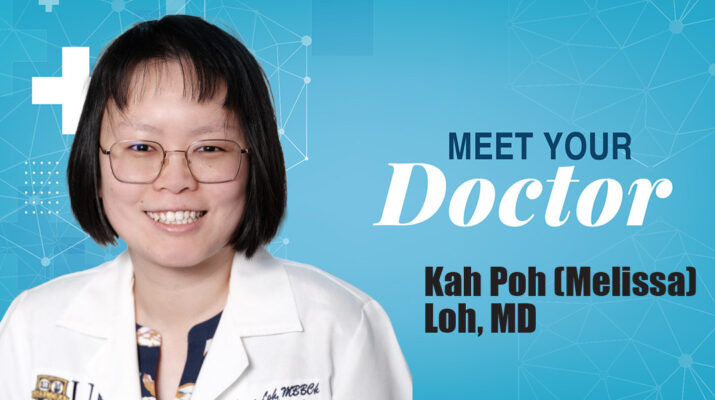
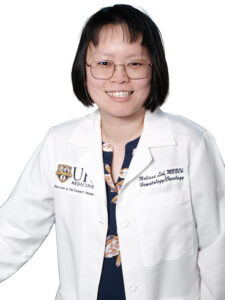
Geriatric hematologist-oncologist at URMC specializes in taking care of older adults with cancer, specifically those with blood cancer. She discusses treatments available and how exercise may play a role in cancer treatment
By Chris Motola
 Q: You work mostly with older adults with cancer, correct?
A: Yeah, older adults with cancer. I divide my time half taking care of older adults with blood cancer as their primary cancer doctor and then the other half is advising other doctors about their older patients who have cancer. So, I give second opinion or provide recommendations to them. And then they are taken care of by their own cancer doctors.
Q: I hear you’re also part of the biggest oncology program in the U.S. Tell us more about that?
A: One of the biggest; it’s hard to know if you’re the biggest. But we have six boarded geriatric oncologists. So, six people went through training in both [geriatrics and oncology] which are completely separate. So, it is probably the place with the most geriatric oncologists.
Q: When we’re talking about geriatric oncology, what age group is included in that?
A: That’s a great question. So, to us, age is just a number and there are two of them. We have chronological age, which is your true age. And then what we call physiological age, which is where if you have two 70-year-olds, one can seem more like a 40-year-old in terms of their energy and fitness and the other more like a 90-year-old, right? So, I think that is more important. Having said that, based on Medicare, older adults is defined as 65 and above. Depending on the cancer type, sometimes we use 60 as the cutoff. So, there isn’t necessarily an age cutoff. It’s the challenges that come with becoming older and us being able to deal with those challenges.
Q: What are some of the challenges of treating cancer in older adults? Obviously, we see higher instances of cancer as you get older.
A: Yeah, so one of the big things is cancer is more common as we get older. But also when we think about taking care of older adults with cancer, the treatments that we have many times were tested in younger people — not older people. So, we have to be creative. Many older adults have other health problems. So, the journey of how to treat them isn’t that smooth. A lot of people end up getting more side effects. They may have to be in the hospital. They might have to go to a nursing home or rehab and oftentimes those things aren’t what older adults want, right? They want to be at home. They want to spend time with family and friends. So, you know, sorting through what matters most to older adults and also what their health is, not just the cancer. They might have heart problem too and are looking to sort through all of these issues and come up with a plan that matches their health goals. And their preferences are not always straightforward.
Q: How do you manage all those comorbidities and considering all those, also take quality of life trade-offs into account?
A: I think a lot of this is trade off. If we could, we would make sure everything is done well, but oftentimes you have to sacrifice one thing to get another thing right. So, the classic example is sometimes in order to live longer, you have to sacrifice some of your quality of life and vice versa. A lot of older people feel like they have lived their life and so care a lot about their quality of life, which means again, spending time at home, not being in the hospital. There are also people who want to live as long as possible just to be here even if their quality of life is not great.
Q: Are there any promising breakthroughs in terms of cancer treatment, both in terms of efficacy and side effects?
A: Well, historically, it’s always been chemotherapy, right? And we think about chemotherapy as something that just targets and kill[s] everything, which means both the good and the bad of the body get affected. And that’s why people end up with more side effects. So, chemotherapy is a little bit more targeted now with fewer side effects. But side effects do still exist. And then the last 20 years or so immunotherapy — what we call immune checkpoint inhibitors — came. That is leveraging your immune system to attack the cancer. There are even less side effects with that. And then, more recently, it’s something what we call CAR T, where we leverage the individual’s cancer signature, pre-process that and then we give them the CAR T-cell back to their own body to then attack the cancer. So, broadly, cancer treatments have become more and more specific and targeted. In parallel, there are a lot of efforts in doing non-drug programs like exercise.
Q: How much does fitness and exercise matter, both in terms of cancer prevention and mitigation, if you already have it.
A: It matters in every setting. There are people who were concerned that older adults with cancer, because they’re getting treatments that are tough, that they couldn’t really exercise or if they can exercise, it could be dangerous. But in the last 20 years there are a lot of data suggesting that exercising during cancer treatment actually makes people feel better in most areas like cognition or thinking, memory, physical function or even anxiety and depression. And where we’re going right now is there’s actually more and more studies suggesting or testing if exercise can modify cancer-related outcomes. Can exercise actually modify how effectively cancer treatments work or can exercise actually affect whether or not the patients respond to treatment or affect whether or not the cancer will recur? And there are some studies suggesting that exercise can also do that, which is exciting. There’s also a lot of efforts in trying to make exercise accessible to patients with cancer. Right now it isn’t necessarily reimbursed. So, access can be a problem. Also a lot of older adults with cancer live in like rural places and have to drive quite a bit to get to exercise programs. So, creating programs and infrastructure to allow people to exercise wherever they are and actually have access to people like physiotherapists and exercise physiologists is important, along with guidance and advice for safety.
Lifelines
Name: Melissa Kah Poh Loh, B.Med.Sci., M.B.B.Ch., B.A.O., M.S.
Position: Associate professor at URMC Division of Hematology-Oncology; director, Geriatric Hematology Research; associate director, Physician-Scientist Training Program (PSTP); chairwoman, Cancer Care Delivery Research, URCC NCORP Research Base
Education: Medical degree from Royal College of Surgeons, Ireland. Completed internship and residency at Baystate Medical Center/Tufts University School of Medicine; in 2019, completed fellowships in hematology, oncology and geriatrics at the URMC/James P. Wilmot Cancer Center. Board-certified internist, hematologist, oncologist and geriatrician.
Hometown: Petaling Jaya, Malaysia
Affiliations: University of Rochester Medical Center.
Organizations: American Society of Hematology, International Society of Geriatric Oncology, Cancer and Aging Research Group.
Family: Husband (an oncologist), and two children
Hobbies: Legos, running
Of Note: Has published over 230 peer-reviewed articles.