
By Deborah Jeanne Post
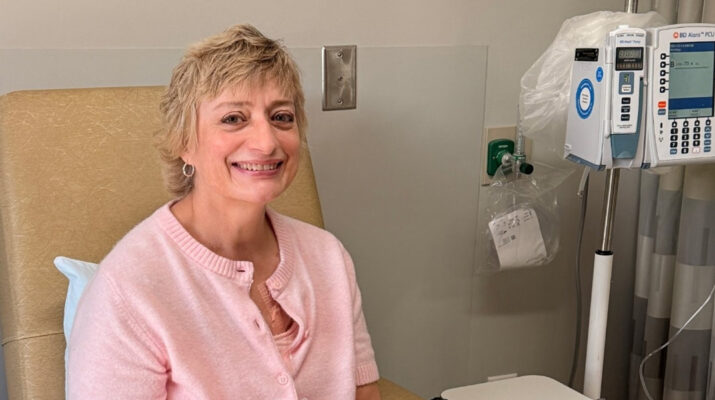
 A self-breast exam likely saved the life of Janis Becker of Walworth in Wayne County.
A science teacher at Wayne Middle School, Becker discovered a lump under her armpit in 2008 when she was only 38. She kept track of it for a few months and sensed it was growing larger. A mammogram and ultrasound prompted a biopsy, which confirmed cancer.
“I had no risk factors or family history or genetic markers,” Becker said. “It can come out of nowhere but there is so much hope for everybody.”
A newer strategy in 2008, she had neoadjuvant chemotherapy, which precedes surgery to kill the malignant cells that may have migrated from the tumor site to elsewhere in the body. The chemotherapy threw her body into early menopause. Fortunately, she had already birthed her two children and felt her family was complete.
After lumpectomy, she remained cancer free until August 2025. That’s when a routine mammogram revealed that cancer had come calling again and that it was a type that is notorious for spreading. Like the previous time, she first had chemotherapy only this time it was a much more aggressive type.
“Unfortunately, it rather knocks you out,” Becker said. “I couldn’t work anymore for the school year. Some chemotherapies are more mild where you take a few days off. This type they said, you will truly be unable to work at least three months, maybe six. All six months, I was unable.”
She recalls sleeping 16 hours a day, along with the predictable hair loss, nausea and general malaise. Becker also experienced neuropathy, one of the side effects from this round of cancer that still bothers her.
Becker opted for double mastectomy to eliminate her chance of recurrence. She also had radiation.
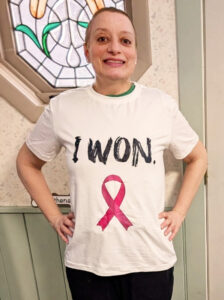
“My body is recovering and I’m back at work,” she said. “I’m back in society and my numbers are good. I might be 56 on paper but parts of my body are more like an 80-year-old.”
She feels gratitude for all of those who helped her during her breast cancer experiences, including medical providers, family, friends and coworkers.
“That makes going through any major health issue so much better,” she said.
She found it strange to have breast cancer at 38 when the average age of diagnosis is 65. Her children — not grandchildren — were only in first and third grades at the time. She appreciated the resources from the Breast Cancer Coalition to help her decide about mastectomy and reconstruction.
“So many people don’t have a good support network,” Becker added. “There is still a very strong support network through your medical team and cancer support groups. They can be inspiring to people who don’t have supportive family, friends or colleagues. No one should feel lonesome and unsupported. There are so many resources.”
And that third cancer? It was discovered when Becker’s oncology team checked over her radiation field and discovered a suspicious mole that turned out to be stage 0 melanoma.
“They immediately said, ‘You’re getting in here this week and getting it taken off,’” she said.
Becker feels thankful for how far cancer treatment has come. When a child in the 1970s, cancer was largely considered a death sentence, spoken of in whispers. She related that people would simply put up with as much misery as they could stand before they wasted away and died.
“There are so many more treatments and ways of handling the side effects that are more manageable,” Becker said. “They’ve come leaps and bounds in a generation. It’s constantly evolving. In ‘08, someone in my situation had a five-year survival rate of 12%. Now it’s 70%. And with my pathological response, 90%. Most cancers are treatable. There’s immunotherapy and there’s so much more we can do.”
She encourages everyone to follow the screening protocols their healthcare providers recommend. Becker and her husband enjoy visiting their grown sons, playing with their dogs and kayaking.
“For me, the biggest celebration is getting back to normal,” she added. “I’m just looking forward to doing normal. Going back to work is great.”