
Area volunteers raise puppies for potential services as guide dogs
By Deborah Jeanne Sergeant
Guide dogs begin their lives like any other dog.
But organizations like Guiding Eyes for the Blind in Yorktown Heights provide special training so the dogs in their program can help people with visual impairment better navigate with confidence.
Before the dogs can participate in the training program, they need to be fully grown and have some basic manners. Instead of kenneling the dogs, placing them with a family for puppy raising will help the animals become better socialized. That’s where puppy–raisers come in.
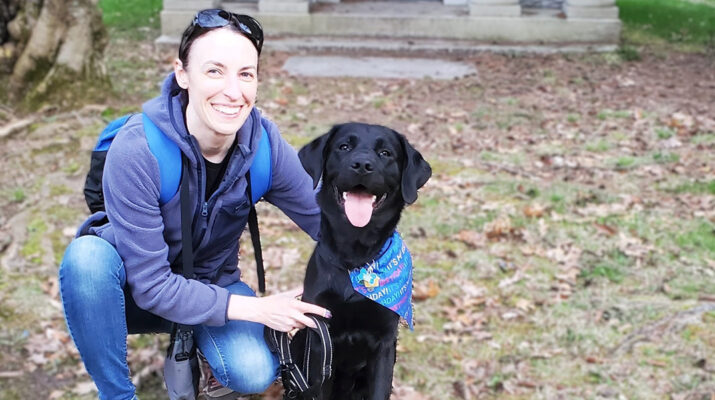
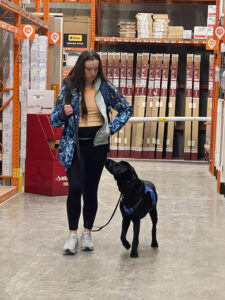
Jamie and Emma Hryunak, a mom-and-daughter team in Spencerport, are raising their first potential guide dog, Sarge. Jamie explained that since they had to put down their previous pet dog, they were not quite ready to own a new animal yet yearned to have a dog around. Emma, an eighth grader, has said she wanted to work with animals some day.
“I thought this would be a good segue into her future,” Jamie said. “This might look good on a college transcript.”
The family also wanted to find a way to volunteer together. Obtaining Sarge during June meant that Emma had primary potty break duty on weekdays since Jamie was working as a pediatric nurse and Emma was on summer break.
The family anticipates Sarge’s return to Guiding Eyes to likely take place between August and October this year.
“We had classes every week and kept building on the skills for puppy training,” Jamie said. “They give you the tools to build on what you learned before. The way he walks on a leash and sits and waits for his food is nice. I could see myself doing this as a retirement gig. Even if I had a family pet again, these are skills I could use to train a family pet.”
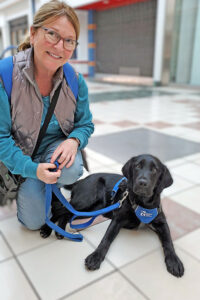
Kate Hurley and Gale McAndrews, a mother—daughter duo in Fairport, have been raising puppies for Guiding Eyes since 2023 when they welcomed Captain, a black Labrador retriever.. Hurley works from home as a compensation manager for a biotech company. Remote work enables her to care for her puppy more easily, although most guide dog organizations do not require this. After about 18 months, the puppy is ready to go back to the agency for consideration as a candidate for training as a guide dog.
“It was amazing,” Hurley said. “I had a very strong connection with Captain. He’s a very laid-back guy and we really bonded very quickly.”
Currently, she and McAndrews are co-raising Oliver, also a black Lab. McAndrews lives just two miles away, so she’s available to dog sit. Hurley and her husband also have a pet dog, cat and a son, age 8. The family enjoys taking Oliver to all sorts of places like family outings and the grocery store. Hurley typically calls ahead to ensure that Oliver will be welcomed and she seldom has problems bringing in a well-mannered dog outfitted in his training vest. ADA law does not cover guide dogs in training, so it is up to business owners and management where these dogs are permitted.
Dogs in programs don’t always “make it” as guide dogs. Health problems, personality issues or resistance to training protocols can disqualify dogs. However, they are always first offered to their puppy raising family and if that won’t work out, placed with a different family or moved to a different “dog career” such as therapy dog or police dog.
Captain’s health issues disqualified him from guiding, but he now lives with Hurley as a pet and serves as a therapy dog with Roc Dog Therapy.
Per the agency’s protocols, dogs in the program learn basics from their puppy raisers like foundational commands, home rules like staying off furniture and not stealing shoes and public behavior like walking well on a leash.
“It prepares them for their next phase of training,” Hurley said. “The more we can do with them, the more they can do with their harness training.”
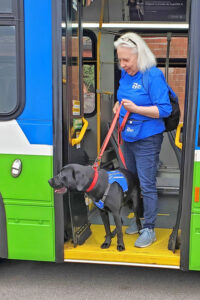
Friends Sherry Fox and Avor Szostak live about a mile apart in Rochester and are co-raising their third puppy after Szostak raised one puppy by herself in 2021.
“Because I work full time and she’s more retired, the last three we’ve done together,” Szostak said. “She’s like my daycare.”
Fox also has children at home, unlike Szostak, so their dogs have more exposure to young people. Jacob, a black Lab, is their current project. Szostak felt drawn to volunteer puppy raising because a cousin obtained a guide dog from Guiding Eyes. She saw how his dog increased his confidence in navigating and she decided she would volunteer with the organization.
“The hardest part is saying goodbye,” Szostak said.
In April, Jacob returns. The knowledge weighs on Szostak as she faces many “last time” events with the dog.
“But it’s exciting because they’re off to do the next chapter,” she said. “It’s a ‘good sad.’ You’ve done your best to teach them so much. You can be proud of how far they’ve come in a year.”
She stays in touch with some of the owners of dogs she helped raise and takes some pride in seeing their accomplishments.
“I feel it’s a win-win situation for the raiser and the puppy,” she said. “The puppy gets to live with you and experience so many different things and we get to see what they turn out to do.”
If you’d like to help but do not feel sure you’re up for an 18-month commitment, agencies also seek volunteers to help for short-term assignments. Lorin Bruzzese, puppy program manager with Guide Dog Foundation for the Blind in Smithtown, calls it a “fostering program” so that puppy raisers can have a break for travel or illness. The organization has local puppy raisers in Rochester and Moravia.
“It can also make sure that the puppy is comfortable with transition,” Bruzzese said.
Typically lasting up to two weeks, puppy fostering involves the same provisions as puppy raising with the agency covering the cost of vet care and supplies as well as providing training.
“It’s a good way to introduce people to the curriculum if they’re interested in puppy raising,” Bruzzese said. “It shows them what it’s like to work with a puppy in your home.”
As with puppy raisers, it’s OK to have other pets in the home. The agency also does not require a fenced backyard and works with volunteers to find places they can play off leash.
“When we have people employed full time, we make sure they have approval to bring the puppy to the workplace,” Bruzzese said. “Four hours is the maximum time the puppy is in the crate during daytime hours.”
Dog crating can provide a low-stress place for dogs to relax while protecting belongings from the puppy’s urge to chew.
“We give a goal of five socialization opportunities a week with a variety of exposure,” Bruzzese said. “It’s for mental development and confidence.”
She encourages anyone interested in volunteering to request information.