
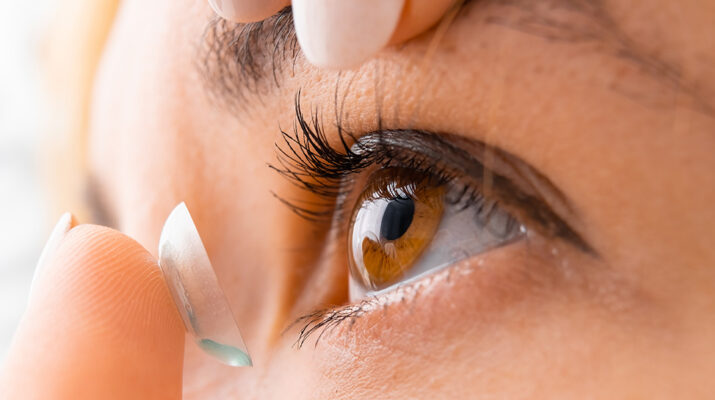
Newer contact lenses, including Acuvue Oasys 1-Day, Biofinity Multifocal, Alcon Total30, and Bausch + Lomb Infuse, are designed to make lens wear easier and more comfortable
By Deborah Jeanne Post
 The latest contact lenses are not just about seeing well but also staying well.
Eye health has always been important. However, newer features offered at your optometrist’s office can make lens wearing healthier and safer, counteracting the issues contact lens wearers encounter.
Dry eyes
More than just the sandpaper feeling of irritation, dry eyes from wearing contact lenses can indicate that the lenses are irritating and possibly damaging the meibomian glands on the edge of the eyelids. The role of these glands is to produce an oil that prevents the eyes’ tears from evaporating too soon. Some types of contact lenses can draw moisture out of the eyes and further dry out the eyes.
Contact lens wearers are always advised to only handle lenses with clean hands, avoid wearing them while sleeping and to spend sufficient waking hours not wearing lenses. These strategies can help combat dry eye. But newer lenses are also helping address the issue of dry eyes.
Lenses like Acuvue Oasys 1-Day and Biofinity Multifocal use moisture-retaining properties to help the lenses remain comfortable all day. Alcon Total30 and Bausch + Lomb Infuse are further examples of lenses with features to improve dry eyes.
“The daily wear lenses don’t need solution and you don’t need to clean them,” said Alan Rifkin, optician at Sterling Optical in Rochester.
One drawback is the higher cost of daily lenses versus weekly or monthly lenses.
Daily lenses cost between $.25 and $.65 per lens ($15 to $39 per month).
Monthly lenses cost between $.15 and $.50 per lens ($.30 to $1 per month, plus $5 lens solution, which costs about $15 and lasts for approximately three months).
Rifkin said that manufacturer rebates can help lessen the expense. Still, weekly lenses can offer a budget-friendly compromise between costly daily lenses and monthly lenses once manufacturer rebates for daily lenses end.
Another drawback is the lenses are made of thinner material, so they’re more prone to fit issues. However, the thinner material is what makes them more breathable.
Poor oxygen supply
It’s important to expose eyes to the air and wearing contact lenses limits oxygen supply to the cornea. This can lead to inflammation and possible lasting changes in the cornea.
Rifkin said that daily wear lenses are thinner and “let more oxygen get to the eye; they’re better for you and are more comfortable.”
The newer lens materials are also more breathable. But lens wearers should still follow the protocols of not wearing them to bed and to allow a few hours without lenses daily.
Improved vision capabilities
Of course, the point of wearing corrective lenses is to improve vision. But today’s contact lenses can correct more vision problems than ever.
“They make them in many different forms for near-or far-sighted and multifocal,” Rifkin said.
For example, Clariti 3 Add Multifocal can correct vision for near, intermediate and distance vision, essentially a trifocal contact lens while improving moisture retention for greater comfort.
Correcting astigmatism with contact lenses is possible with toric lenses, as these are made so that they orient in the eye correctly, such as Acuvue Oasys 1-Day for Astigmatism.
Eye protection
UV rays and the blue light from digital screens can make it harder to see, causing fuzziness around light, particularly in low light situations for people older than 40. Over time, UV rays and blue light can damage eyes and contribute to conditions such as cataracts, which require surgery to remove the effected lens in the eye and replace it with an artificial lens. New contact lenses equipped with OptiBlue™ Light Filter technology such as Acuvue Oasys Max 1-Day help protect eyes from UV rays and blue light (but sunglasses are still recommended for extra protection, as these lenses filter only about 60% of blue light).