
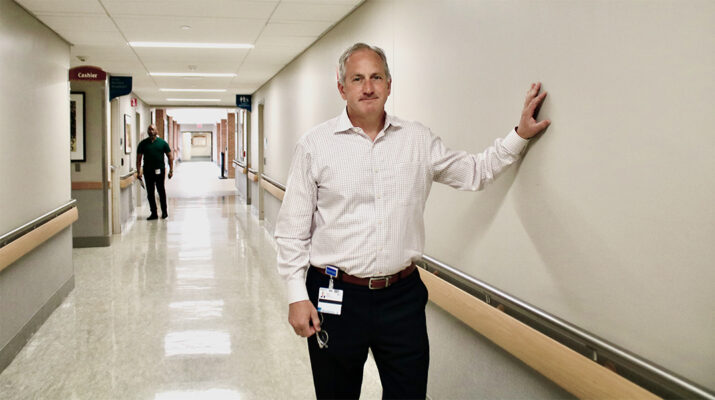
G. Randall Green is a cardiologist and the new president of Rochester General Hospital. He has a law degree and an MBA, is an active surgeon, educator and writer. His charge is to help steer Rochester General “to become a national model of health and healing”
By John Addyman
 G. Randall Green, a cardiac surgeon, has a new job as president of Rochester General Hospital. And with it, a simple goal.
“To become a national model of health and healing,” he said.
And the mechanism to do that?
“Close, transparent information [that] creates an organizational culture that is adaptable to all the challenges of healthcare, that creates a spirit of trust and the closeness that we want from our community of caregivers,” he explained.
And how is that applied?
“We want everyone to understand more of what senior leadership knows, sees and understands about the future of this hospital, this system and healthcare,” he said.
Spend 15 minutes with the good doctor and you, too, may come to the realization that this clearly appears to be the right guy to do all that.
Three days a week Green, 57, starts his day at Rochester General at 7 a.m. in an operating room, healing. The commute from his home in Skaneateles is an hour and 15 minutes.
“I’m pretty much doing phone calls all the way in and back home at night,” he said. “When I get home, I’m done.”
The calls end “when I’ve got everything buttoned up,” he added.
He’s also a lawyer.
“I went to Syracuse University College of Law full-time when I was a surgeon [at Upstate Medical University in Syracuse],” he said. “I finished in three years. The only rule was, my wife told me, ‘The kids have to be in bed before you start studying.’”
And Green has an MBA from Cornell. He got interested in medical device innovation when he was completing his surgical residency at Stanford.
“I’ve had a few medical device companies that I’ve started,” he said.
He joined Rochester General in 2024 and is the executive medical director of the Sands-Constellation Heart and Vascular Institute. He has been on the staff at St. Joseph’s and at Upstate Medical University hospitals in Syracuse. He has published, taught and innovated.
And when he closes his eyes and envisions a patient under the care of his Rochester General staff, he sees a host of people with different jobs surrounding that patient — doctors, nurses, techs, volunteers and family — joining him in the effort.
On a May Monday morning, he got to work a little early.
“Today I started serving coffee to staff as they were getting on or coming off their shifts,” he said. “Then I had a meeting about nursing ratios and staff. I make the rounds on different floors to make sure we’re close to the staff and knowledgeable about the challenges they’re encountering so the things we can solve, we solve quickly.”
He moves through the long bright halls of the hospital with the gait of a guy who is perfectly comfortable in his surroundings. It’s something he’s earned.
“My mom was a nurse,” he explained. “I was in a hospital when I was 10 years old, doing my homework. I have been in a hospital every day since. I know how these things work.
“Healthcare is more challenging now as a job because of the staffing concerns — not just here, everywhere — because of the financial constraints and other headwinds. It takes a toll on the people who come in here and want to do a great job. They’re asked to give more than any human should have to give to do their job. They show up every single day with a smile on their faces and do that great job as a community resource, for all the right reasons, to take care of patients.”
Green looks at his situation and sees the support he needs to help everyone do their best.
“The job of the president is to work closely with the senior leadership team. We have an outstanding chief operating officer and an outstanding chief medical officer, chief nursing operator — all the functional areas of the hospital are essentially covered by people within that senior leadership team.
“In my role as president, I have one-on-one meetings with each member of my senior team. Half an hour each. I ask them to come in with an agenda, what are they working on, what are their priorities, where do we stand against those priorities, their goals and we run through that for half an hour. My job isn’t to manage them, but to sit with them and make sure a person with line of sight into all functional areas can be confident that we’re achieving the mission of this hospital — it’s managing the people who actually do the real work.”
CEO Chip Davis and Jennifer Eslinger, president of healthcare operations and COO, have been hosting town halls that Green describes as “a mixture of state of the union and the ability of our health community to react.” In frank and open discussions, staff members know what’s happening and are hearing it straight from the top.
Green is helping people understand his role.
“I think people see me as a heart surgeon now. I’d like to be seen as somebody who is a resource for our employees, our staff, our patients and their families to make the employee experience and patient experience as great as it can be here at Rochester General,” he said.
He’s fully aware that healthcare costs are an issue. But promises Rochester Regional Health isn’t waiting for the shoe to drop on proposed Medicaid cuts.
“What we truly need to focus on to make healthcare less expensive is quality and patient safety,” he said. “When we supply high-quality care, we don’t incur complications, we incur shorter hospitalizations, we decrease the number of readmissions and all that stacks up to a greater return for us as a hospital to reinvest in the equipment, the people and the building itself. That creates a virtual cycle of a higher-quality institution that looks better and feels better and more patients want to come here.”