
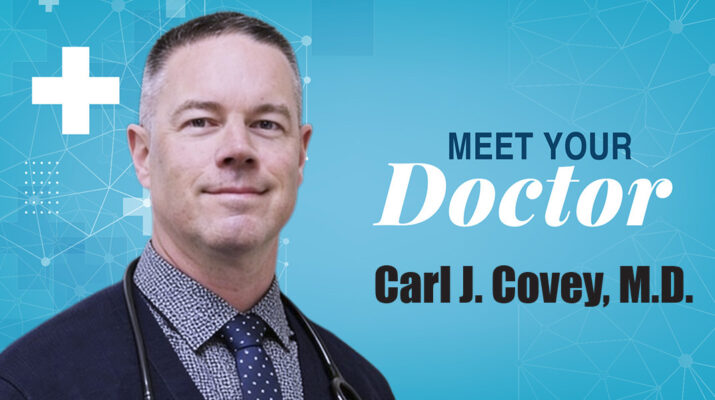
Doctor retires from the Air Force after 24 years, embarks on a new path in direct primary care in Rochester. He explains why
By Chris Motola
 Q: You’re currently in the process of transitioning into a direct primary practice. What were you doing before that?
A: I actually just had my last day of active duty in the Air Force after 24 years. So today is my first day as a full-fledged civilian. My last station I was in California. Moved out here about three weeks ago. I was doing military medicine and prior to getting out, was looking for jobs in the direct primary care or concierge model. I had a few friends that were doing it after they got out of the military and they really, really liked it. I looked into it. I emailed Dr. [Laura] Petrescu [of Athena Direct Primary Care & Lifestyle Medicine in Pittsford] eight months ago or so. And then we just started talking and she eventually offered me the job. This will be my first foray into civilian medicine, but also into direct primary care.
Q: That’s quite a transition too because both on the military side and the concierge side.
A: In the military I was a full colonel, so I was in charge of a lot of things. I ran the sports medicine fellowship program out there. But because of my rank and my experience, I had a lot of control over my schedule. And my appointment times were a little bit longer than they were, you know, 10, 15 years ago. Normally, primary care docs get 15 minutes to see folks to take care of all of their problems, to listen to their stories, to refill all their medications. That’s just not a lot of time. In the DPC [direct primary care] model you don’t have as many patients or see as many patients per day. The appointment times are as long as they need to be, whether it’s 10 minutes or 90. You get to spend a lot of time with your patients and you get to really know the patients, you get to really take care of the patients. You get to kind of work with them as a team and tailor their care. To tailor their care to them and you get to spend a lot more time dealing with and talking to them about prevention. I think it’s a win-win model for everyone.
Q: How will your practice deal with insurance? I know this style of practice can vary in what, if anything, it bills to insurance.
A: The model I am going to be working in is relatively straightforward in that we don’t accept any insurance. We don’t bill insurance, we don’t bill Medicaid or Medicare. Patients pay a flat monthly fee and they get total primary care in that monthly fee. We definitely recommend that people have insurance for emergency care, surgeries, hospitalization. Medications, X-rays, MRIs and labs I order when the patient wants to get those things done and they can use their insurance on those, but I’m not billing their insurance directly. I know some concierge practices and some other DPC practices do charge insurance for their visits, but we will not be doing that.
Q: What kinds of patients does the DPC model tend to attract? Is it people who are more into health tracking? Is there a lot of sports medicine involved?
A: I am kind of new to it, so I can’t say for sure. I will say I’ve had several kinds of meet and greets. Most of my patients so far have been kind of older, not like young active super like sporty people. But they are active older people. So, they have like aches and pains and they have arthritis and they have all of the normal musculoskeletal problems that I see. But I’m not sure. I think honestly the practice will attract whatever you want to tailor it to. I do think DPC practices generally attract more people that are wanting to deal more with prevention. I think maybe people with more complex issues might funnel towards DPC more, because it’s really hard for a primary care physician to understand their conditions in 15 minutes. But I am welcoming all sports medicine patients because I am board–certified in that and I really like it.
Q: What does a direct primary care physician do with that extra time?
A: I think one of the things that has been a struggle for me and a lot of my colleagues were that we’re seeing clinic, you know, every day. We’re constantly in the grind. And during that time a lot of clinical questions come up during the day and it’s really hard to remember them and then go research them and try to find the answer. The clinical curiosity that you get as a primary care doc is always there. But sometimes it gets burned out of you because you just don’t have time to research it. And if you do, it’s always just an added-on task to the end of the day. Or you know, a lot of people they still have charts to do at the end of the day. They have families, they have friends, they have other obligations. A lot of us became doctors because we love learning and it’d be really nice to be able to have time in the day to look stuff up, to learn stuff again, just to better help patients.
Q: What is something transferable from the military into civilian medicine that maybe somebody who’s always been in civilian medicine might not think of or be familiar with.
A: Oh, that’s a great question. I don’t know; I don’t want to bad mouth my civilian colleagues. I am one now. I think that in the military, you get really used to working with a team. It’s the biggest team in the world. I’ve always been a sports guy and I’ve always loved being on a team. But you always have a shared goal; you have a huge, big shared goal. And then within your clinics, everybody’s working towards the same thing. Everybody that I’ve talked to about what do they miss when they retire from the military? Almost 90% of them have told me they miss the team and the shared goals. It’s not that there are no teams or goals in civilian life, but they tend to be a little more fragmented. That’s part of why I want to treat my patients not so much as patients but part of a team. I want to learn from them as much as I’m helping them. I don’t want to just make decisions for them like, hey, I am the doctor, so you have to do this. I want to lay out their options and then they get to decide what they want to do based on their wants and desires, knowing what the risks and benefits are.
Lifelines
Name: Carlton Covey, M.D.
Position: Primary care and lifestyle medicine physician at Athena Direct Primary Care & Lifestyle Medicine in Pittsford
Hometown: Caledonia
Education: Ithaca College, Bachelor of Science in exercise science and cardiac rehab — Cum Laude; University of Georgia, Athens (Master of Education: Exercise Physiology); Uniformed Services University, Bethesda, Maryland (Doctor of Medicine); Malcolm Grow Medical Center, Andrews Air Force Base, Maryland (residency in family medicine, chief resident 2008-09); Michigan State University, East Lansing (faculty development fellowship); Uniformed Services University, Bethesda, Maryland (Primary Care Sports Medicine Fellowship); Air War College (correspondence), Air University
Career: Mike O’Callaghan Federal Medical Center, Las Vegas, Nellis Family Medicine Residency: Medical director (most recently)
Organizations: American Academy of Family Physicians, American Medical Society for Sports Medicine, American College of Lifestyle Medicine.
Family: Wife (Jen), son (6), daughter (2)
Hobbies: Fly fishing, hiking, playing and watching sports