

By Deborah Jeanne Sergeant
As part of the autonomic nervous system, breathing is a function that we don’t have to think about. However, breathing with intention can support good health.
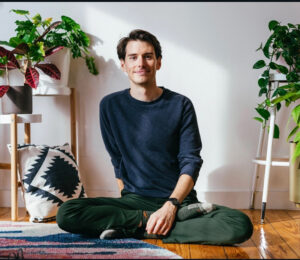
Eli Harrigan, certified breathwork facilitator and owner of Breathe with Eli in Victor and Pittsford, said that although there are many kinds of breathwork and ways of breathing to cause different effects, his type is basically a tool for unwinding and releasing chronic holding patterns.
“Basically, on some instinctive level, we need to feel our feelings,” he said. “We can drop into the full feeling sense in the body. In doing so we have access to emotions and sensations that we refer to things the adult filter mode screens out.”
Suppressing emotions can contribute to all sorts of health issues because of the body-mind connection. Harrigan listed tension, back pain, headaches and indigestion. He believes that breath can help with focusing energy and it can help with chronic pain.
“Often there’s a distinction between pain and suffering,” Harrigan said. “Pain is an unpleasant sensation, but suffering is pain plus resistance to the feeling. It’s bracing against the physical and emotional pain.”
Breathwork can help people acknowledge and let go of the pain they experience.
Harrigan said that his style of breathwork involves breathing in deeply and exhaling through the mouth, releasing the breath with a sigh. A session may last an hour or two and include aroma therapy or a sound bath.
Breathwork is also part of many types of yoga and martial arts styles. One of the latter is Kuk Sool Won, a comprehensive practice of 32 Korean martial arts. Gary Evarts, 9th degree black belt and owner of Kuk Sool Won of Williamson, regularly leads students in “ki breathing” exercises.
“The ki breathing connects with meditation,” Evarts said. “With ki breathing you inhale through the nose, exhale through the mouth. The timing for that breathing might be two seconds and some people naturally breathe in four or five seconds in and four or five seconds out. We don’t really hold our breath.”
Those practicing Kuk Sool Won use “ki breathing” to help focus for tasks such as breaking a board and as a means of settling the mind and body as a class concludes. But Evarts said that in everyday life, ki breathing can help with relaxation, stress reduction, clearing the mind and stabilizing mood.
Oftentimes when people try breathwork during meditation, their minds are wandering about tasks to do or left undone instead of concentrating on their breathing. But Evarts said that letting these thoughts go as fast as they come in can help clear the mind and improve focus.
“There’s a lot of power behind breathing and meditation,” he added. “You don’t have to be in martial arts. Lie on your back and take deep breaths. You don’t have to do 12 postures like we do.”
Practitioners breathe in through their noses and exhales through their mouths. Breaths should reach deep, causing the belly to rise.
Carol Scheg-Morissette, owner of Healthy Alternatives Wellness Center in Rochester, said that breathwork “supports good physical health by activating the parasympathetic nervous system, which lowers blood pressure, reduces stress hormones like cortisol and improves heart rate variability to build physical and emotional and spiritual resonance.”
Scheg-Morissette is a licensed massage therapist, Reiki master teacher, integrated energy therapy master and certified sound healer.
She added, “ancient practices such as pranayanna help to regulate and control breath. It reduces anxiety and stress by helping to bring you back to the present moment while informing the nervous system that you’re safe.
“Controlled breathing exercises can be used for a coping strategy in stressful situations,” she said. “You can lower your blood pressure with slow deep breathing exercises.”
She also recommends breathwork for people with lung conditions such as COPD and asthma, athletes and elderly people to help strengthen their respiratory muscles and improve oxygen intake.
Breathwork “improves communication between the brain regions involved in emotional regulation, behavior and cognition,” Scheg-Morissette said. “It helps facilitate interoception which is the awareness and understanding of your body’s internal sensations. It would be great for anyone who has Parkinson’s, Alzheimer’s or a brain injury. It can help to bring oxygen to the brain and bring it back into balance to accelerate the healing time.”
She added that improving breathing also supports healthy digestion, blood circulation, mental health and releasing toxins.
“It helps to bring you into the present moment and improve your focus and increases your attention span leading to a sense of common focus that can help fight cravings and addictions,” Scheg-Morissette said. “Breathwork can also help with creativity because it relaxes and clears the mind which lets new ideas begin to develop and flow.”
She leads breathwork by having participants lie on a meditation mat in a dark, quiet room. She explains the process and the group “practices” before the session begins. Breathwork involves breathing from deep within the abdomen, so oftentimes with a hand on the abdomen and the other on the heart to better feel the process.
The breathwork lasts about 25 or 30 minutes followed by a 10-minute rest.