
Hyperbaric oxygen therapy helps treat a wide range of conditions — from wounds, anemia to tissue damage and other injuries
By Mike Costanza
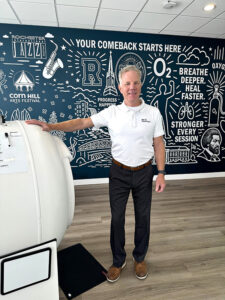
Those in the Rochester area can turn to MD Hyperbaric-Rochester for hyperbaric oxygen therapy.
“It is functional and wellness hyperbaric treatment,” said George Cananaugh, the owner and director of the Fairport facility, which held its grand opening in September.
In a nutshell, hyperbaric oxygen therapy boosts the amount of pure oxygen in a patient’s blood plasma.
As plasma flows through the patient’s body, the higher concentration of oxygen can increase its ability to fight infections, reduce the swelling resulting from wounds or injuries, help repair damaged tissues and provide other therapeutic benefits.
The FDA has approved the use of hyperbaric oxygen therapy (HBOT) as an adjunct therapy, one to be used alongside regular medical care in the treatment of wounds, tissue damage resulting from radiation therapy and other injuries and conditions (see sidebar).
MD Hyperbaric-Rochester offers HBOT not just as an adjunct therapy, but also “to support those who are looking for additional healing that they would get beyond that in an acute care-type setting,” Cavanaugh said.
A follow-up email to his interview stated that the treatment is capable of “supporting healthy aging, sharpening focus,” and “serving as a complementary protocol for complex neurological conditions such as Alzheimer’s and Parkinson’s,” and “offers a science-backed, compassionate approach to cognitive vitality and long-term wellness.”
MD Hyperbaric-Rochester is one of chain of MD Hyperbaric franchises in the US and is not a licensed medical facility. A nurse practitioner who is licensed to provide medical care oversees the provision of HBOT and emergency medical technicians do the actual treatment.
“We find that they kind of do best because they see a wide range of people and they’re good at addressing any issues and concerns,” Cavanaugh said.
Cavanaugh went on to say that the EMTs and the rest of the people who provide HBOT at MD Hyperbaric-Rochester are IBUM certified hyperbaric technicians. IBUM, the International Board of Undersea Medicine, trains hyperbaric technicians, physicians and others who work in the field of hyperbaric medicine.
Cavanaugh’s employees had to pass a 40-hour online IBUM course and undergo another 40 hours of on-site training from MD Hyperbaric before working with patients. The facility’s hyperbaric chambers have been approved by the FDA.
Patients who come to MD Hyperbaric-Rochester initially sit down with the facility’s nurse practitioner.
“Our NP has a consultation with patients and reviews medical history with them… sometimes requesting info from their other providers,” Cavanaugh said. “She does this before prescribing a protocol for number and types of sessions and frequency of sessions.”
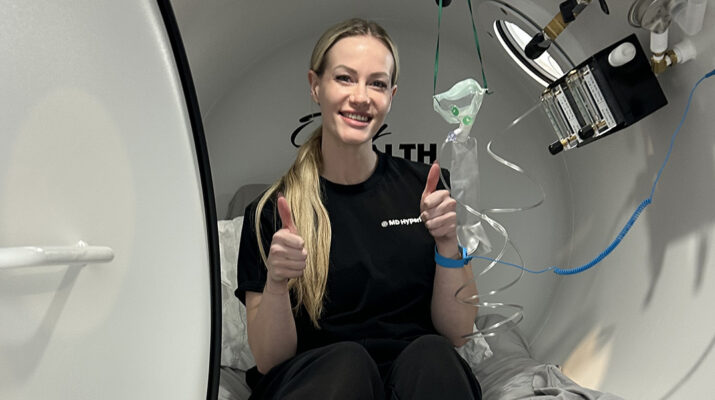
A single spark in an oxygen-rich environment can cause a deadly fire. In order to reduce the risk of generating static electricity, the clinic has each patient put on a 100% cotton gown and remove watches and other personal items prior to entering a hyperbaric chamber. To further reduce the risk, the patient wears a bracelet that grounds him or her to the chamber and the chamber is grounded to the floor.
At the beginning of treatment, the patient enters the chamber, which has transparent walls, and dons an oxygen mask. The chamber is then pressurized with room air to 1.5 to 2 atmospheres (one atmosphere is the average atmospheric pressure at sea level). The room air contains just 21% oxygen, but the mask delivers 100% oxygen to the patient.
“Our technicians are there at the chamber pressurizing, depressurizing, and while their patient is in there receiving oxygen they are being monitored, watched and available to communicate if needed,” Cavanaugh said.
Though other HBOT treatments involve pressurizing the chamber with pure oxygen, the combination of a mask and chamber is also used, particularly when the chamber can accommodate more than one patient.
“The benefit is the oxygen in your blood, not the oxygen surrounding you,” Cavanaugh said. “That’s the point of hyperbaric.”
Sessions typically last one hour but can stretch to as much as 90 minutes if the treatment calls for it.
Patients could read if they brought the material and are given two to three five-minute breaks. Every five sessions they are asked to fill out surveys about how they feel about their progress, and after the first 10 sessions the nurse practitioner seeks to determine how well the treatment is working.
“She has a call at 10 sessions, and reviews our documentation from each session,” Cavanaugh said.
Some patients might undergo as many as 40 sessions.
According to Cavanaugh, most of MD Hyperbaric-Rochester’s patients have spoken positively of HBOT.
“Usually, the first day people say, ‘Wow, I had the best night’s sleep I ever had,” he said. “Some people take it and say, ‘Wow, I was full of energy.’”
When to Undergo Hyperbaric Oxygen Therapy?
According to an article on the website of the nationally recognized Cleveland Clinic, the U.S. Food and Drug Administration (FDA) has approved hyperbaric oxygen therapy (HBOT) to help treat the following injuries and medical conditions:
Air or gas bubbles in blood vessels (an air or gas embolism).
The bends, also known as decompression sickness.
• Burns.
• Carbon monoxide poisoning.
• Gas gangrene.
• Hearing loss.
• Injuries or wounds that have resulted in cuts or breaks in the skin.
• Loss of vision.
• Radiation injuries.
• Severe anemia.
• Severe bone and skin infections.
• Skin grafts.
• Trauma from force or pressure on a body part.
The article went on to point out that some medical spas or facilities that offer alternative medicine might claim that hyperbaric oxygen therapy helps treat other conditions, such as hair loss, autism and cerebral palsy. According to the article, there isn’t enough medical research to support the use of HBOT to safely and effectively treat these conditions.