
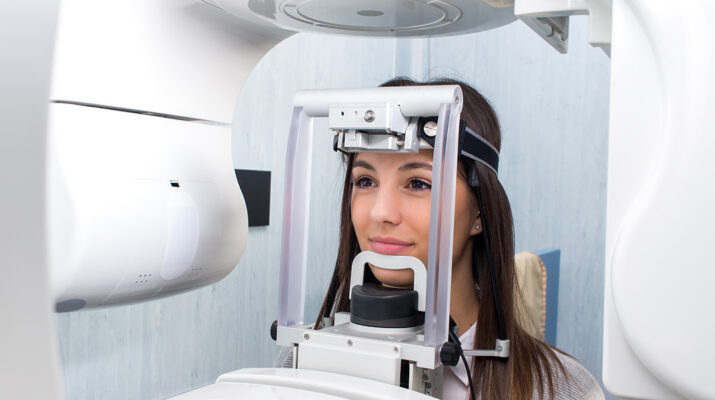
Everyone who’s had regular dental care knows the heavy lead apron that’s draped across your body before taking X-rays of your teeth.
But what has been an annual ritual of donning the apron and undergoing oral X-rays might look very different the next time you visit the dentist, based on new American Dental Association (ADA) guidelines.
Dental X-rays should be ordered only when clinically necessary, to minimize exposure to radiation for both patients and folks working in a dentist’s office, according to guidelines published in the Journal of the American Dental Association.
In other words, a person might not need X-rays of their teeth every year, based on their dental health.
“This means that there is no ‘one size fits all’ when it comes to the interval between dental X-rays,” says the ADA’s webpage on X-rays.
The lead apron also could become a thing of the past, with this updated guideline and previous guidelines stating they’re no longer necessary due to low levels of X-ray radiation and better technology.
“Dental X-rays are safe. In some cases, a dental X-ray delivers less radiation than a single day of the natural radiation we are all exposed to just by living in the world,” said lead guideline author Erika Benavides, a clinical professor of periodontics and oral medicine at the University of Michigan School of Dentistry.
“Yet,” she added in a news release, “It is important to follow the ALARA (As Low As Reasonably Achievable) principle recognized in both dentistry and medicine to minimize exposure over a patient’s lifetime and only order X-rays when clinically necessary.”
Dentists should consider a person’s current oral health, their age and any signs and symptoms of tooth decay or other disease before ordering an X-ray, the ADA guidelines state.
Dentists also are encouraged to discuss the need for X-rays with patients as part of shared decision-making, the ADA says.