
By Deborah Jeanne Sergeant
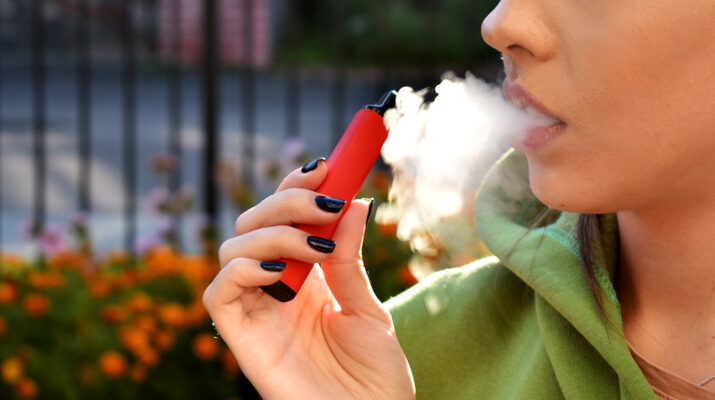
Electronic cigarettes, commonly called vapes or JUUL (a popular brand of e-cigarettes), do not represent a safe alternative to standard incendiary cigarettes.
Physician Josephine Adunse, medical director of the Lung Cancer Screening Program at Rochester Regional Health as well as a pulmonary and critical care medicine physician at Rochester General Hospital, said that e-cigarettes are “associated with significant health concerns, particularly respiratory [lung] disease.”
The devices look like a marker or USB storage device and work by superheating liquid (“vape juice”) so users inhale a vapor that’s often enhanced with flavors and scents such as menthol and various foods. Initially, manufacturers billed e-cigarettes as cessation devices for people already smoking regular cigarettes. However, “a large proportion of young adult users have never smoked combustible cigarettes, raising concerns about nicotine initiation and addiction in this group,” Adunse said.
The percent of youth younger than 18 using e-cigarettes is low. However, 18% of those aged 18-24 report current use and 9% daily use in the most recent statistics. Adunse also stated that the gender gap has closed as slightly more young women are using e-cigarettes than young men. Young onset of use means longer-term use and thereby a longer exposure to the unregulated chemicals and, in some cases, the nicotine inherent to vaping liquids.
“E-cigarette use is associated with increased prevalence of asthma and earlier asthma diagnosis, especially among youth and dual users, those who use both e-cigarettes and combustible cigarettes,” Adunse said. “There is also a higher prevalence of COPD among dual users. The American Heart Association highlights concern about nicotine addiction, potential for transition to combustible tobacco and unknown long-term cardiopulmonary risks, especially in youth and young adults.”
In addition to most vaping liquids containing addictive nicotine, the devices use aerosol, which contains not only water vapor but “ultrafine toxic particles, heavy metals like lead, tin and nickel and volatile organic compounds,” said Jennifer Lee, lead lifestyle counselor at URMC’s Center for Community Health & Prevention. “Flavoring have acetol, which is linked to a serious contribution to lung disease or popcorn lung. All of these compounds can interfere with lung function and increase risk for heart disease, lung cancer and other cancers and long-term cancer risk.”
As for people who already smoke, using vapes to quit nicotine is ineffective, as Lee said it’s challenging to identify the dose of nicotine while using a vape, unlike nicotine patches or gum. A vaping device can offer the equivalent of 200 cigarettes per refill. Like eating snacks by the handful rather than from a portioned container, it’s tough to tell how much nicotine a user takes in from a vape.
“We have patients who are shocked when we do calculations as to how much nicotine they’re getting in a day,” Lee said. “It can be the equivalent to a couple of packs.”
The delivery device also makes a difference. The ritual of lighting a cigarette and smoking it down to a butt measures the amount of nicotine dosed in a single smoking session, unlike a vape.
Lee said that most people face little social stigma around vaping compared with cigarettes, a shift which has increased the latter’s popularity. Ambiguity about “no smoking” ordinances (does it apply to vaping?) has also contributed to vaping’s popularity.
Lee hopes to see more policy changes influencing vaping and additional access to education as a means to drive down usage.
Physician Holly Ann Russell, associate professor of family medicine, and director of Family Medicine Substance Use Disorder Programs at URMC, offered a little good news in that high student usage has dropped from 25% in 2024 to 8% of high schoolers currently.
“We are making some strides with young people,” Russell said. “There has been quite a bit of education that’s gone out. In the early 2010s when vapes were first introduced, there was misinformation about them being harmless water vapor that’s safe to use.”
She believes that tobacco companies have purposefully worked to addict young people to vaping by using vape liquids flavored like candy and fruit. There’s also the novelty, hint at rebellion (since it’s easy to hide vaping from parents) and technology used in the devices.
“They’re priming the dopamine circuitry at a young age,” Russell said. “The adolescent brain is at a developmental stage where the brain is growing circuitry at a fast rate. If you start to use a product that literally changes your brain chemistry, it changes the reward circuitry and primes you for future addiction issues, not just combustible cigarettes.”
She said that more education aimed at helping parents and more education in the school systems will help curb usage. Instead of simply suspending students caught vaping, providing cessation treatments will likely result in fewer students using e-cigarettes.