
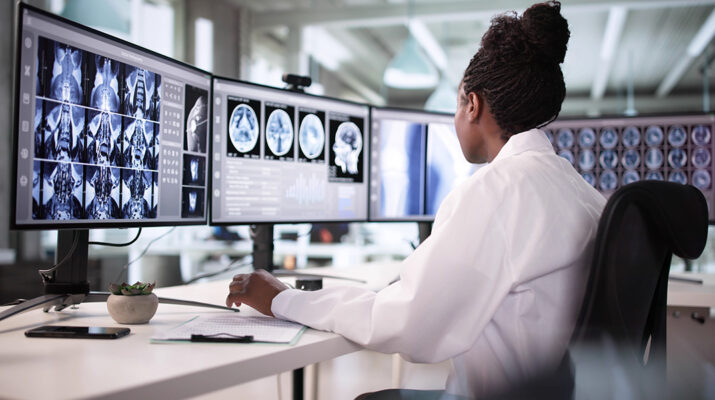
MRI, X-Ray, CT Scan, PET, Sonogram
By Deborah Jeanne Sergeant
 If you’re sick or injured, you may receive imaging from a healthcare provider, depending upon what’s going on. But what type of imaging you receive differs for many reasons.
Imaging is “complex and nuanced,” said physician Raymond Tan, chief of medical imaging at Highland Hospital. “There are certain things where you do a test and it offers a straightforward, definitive answer. Those cases are easy for people to understand. You have a cough and you get a chest X-ray to show you have pneumonia. But there are other times where it’s more complicated.”
Tan said that confusion often enters when an ultrasound may give some but not all the information a provider needs, so a CT scan is necessary, for example. Sometimes the standard practice type of imaging for a case does not reveal sufficient information for providers to diagnose and form an effective treatment plan. Then providers may turn to a different type of imaging.
In general, X-ray is the most commonly performed type of imaging exam in medicine by volume as it is inexpensive and provides a good look at things such as bones.
“Some things will be hidden on X-ray as it’s a two-dimensional image,” Tan said. “Some things won’t be apparent. That’s why if you have something that’s persisting you may go on to another test. Certain things won’t be visible. A CT scan is an image we can look at in any plane. It looks at the patient in all directions with finer detail. Enlarged lymph nodes or a muscle problem won’t show up on an X-ray.”
Sonogram, also called ultrasound, is the typical go-to for prenatal scans, as it excels at soft tissue imaging, and for other issues like a lump on the arm. It’s relatively inexpensive.
But MRI or CT may be used for more complex issues or if sonogram does not reveal necessary information.
“Radiation safety is something I get asked about a lot,” Tan said. “If you get a CT scan today, it is dramatically less radiation than it used to be 15 years ago and 10 and even 5 years ago. The less radiation we give people there’s more noise in the image. We use computers to remove the noise and make the image clearer. We can see more with less radiation used.”
Physicians work with radiologists who read images and together they develop answers for patients, such as a diagnosis and treatment plan.
“Doctors choose imaging techniques based on the medical question they need to answer,” said physician Adam Zinkin, with Rochester Regional Health and chief of diagnostic imaging. “Factors such as the body part being examined, the urgency of the situation, radiation exposure, and the level of detail required all play a role. Often, multiple imaging methods are used together to provide a more complete picture.”
Some people may think that the “latest and greatest” imaging technology should be used because surely it must be the best. But Tan said that’s not necessarily the case. Instead, the type of imaging that is best is “about selecting the most appropriate tool to ensure accurate diagnosis and effective treatment,” he said. “As radiologists, we welcome consultation with referring providers to help determine the most appropriate method to answer a diagnostic question.”
X-Ray, CT Scan, PET, MRI
Physician Adam Zinkin, chief of diagnostic imaging at Rochester Regional Health, explains how medical imaging works:
X-rays
“X-rays are the oldest and most widely recognized form of medical imaging. They work by passing a small amount of ionizing radiation through the body. Denser structures such as bones appear white on an X-ray image, while less dense tissues appear darker.
Computed tomography scanning (CT scanning)
“CT scanning builds on x-ray technology to create more detailed images. A CT scanner rotates around the body and allows images to be seen in cross-sectional views. These images allow doctors to examine organs, blood vessels, and soft tissues with much greater clarity than standard X-rays. One of the main drawbacks of CT scans is their higher radiation exposure compared to standard X-rays, which is why doctors weigh the benefits carefully before ordering them, especially for children.
Magnetic resonance imaging (MRI)
“MRI takes a completely different approach. Instead of radiation, MRI uses strong magnetic fields to produce images. This technique is especially effective for visualizing soft tissues such as the brain, spinal cord, muscles, and ligaments. MRI scans can reveal subtle differences in tissue structure, making them essential for diagnosing neurological disorders, joint injuries, and certain tumors. Another advantage is that MRI does not expose patients to ionizing radiation. However, MRI scans take longer, are more expensive, and require patients to remain still in a confined space, which can be uncomfortable, particularly for claustrophobic patients, though MRI technologists are typically quite adept at assisting claustrophobic patients through these exams.
Ultrasound
“Ultrasound imaging relies sound waves rather than radiation or magnets. These sound waves bounce off internal structures and create real-time images that doctors can observe as they are generated. Ultrasound is often used to assess fetal development during pregnancy. It is also widely used to examine the heart, blood flow, and abdominal organs. Because ultrasound does not utilize ionizing radiation, and is relatively inexpensive, it is often used as a first-line imaging tool. Its limitations include lower image resolution compared to MRI or CT scans and reduced effectiveness when imaging areas are blocked by bone or air.
Positron emission tomography (PET)
“PET scanning, focuses on how tissues function rather than how they look. Patients receive a small amount of radioactive tracer, which accumulates in areas of high metabolic activity. These areas appear brighter on PET images, making the technology particularly useful in cancer diagnosis and treatment monitoring. PET scans can identify disease at an early stage, sometimes before structural changes become visible on other imaging tests. Because PET scans are costly and involve radioactive materials, they are usually reserved for specific clinical situations and are often combined with CT scans for greater accuracy.”