
Foot expert: ‘Do not hesitate to ask for help’
By Deborah Jeanne Sergeant
Taking good care of your feet can help you stay active and doing what you enjoy. It can also reduce risk of falling.
According to the Centers for Disease Control and Prevention, falls are a leading cause of injury for adults 65 and older and can lead to deconditioning, lifelong disability and death.
Sometimes, poor nail care can cause problems with gait and even wearing shoes.
Andrea Whitcomb-May, certified master pedicurist and certified podologist and owner of Andrea’s Foot Care and Nails in Perinton, provides foot care throughout the Rochester area. She has helped clients who are unable to care for their feet because of flexibility or fine motor skill limitations.
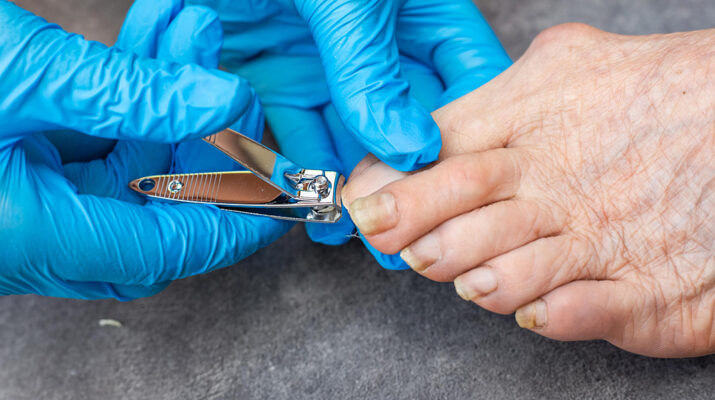
“Do not hesitate to ask for help,” she said. “Quite often, our nails get too long or too thick for us to safely clip them ourselves and we can’t see what’s going on underneath the nail. Sometimes skin is nearby where we’re clipping.”
The “quick” under the nail can become sore, painful and even infected if it is cut open during a nail trim. The quick tends to grow along with the nail, so if nails become too long, the quick is also longer than normal.
For many people, nails become thicker with age. That, combined with less steady hands, reduced ability to reach the feed and diminished eyesight, make it tougher for many older adults to trim their own toenails.
“If you can’t care for them, a quick filing with a nailing file can take them down until you get some professional care,” Whitcomb-May said. “Drinking enough water to hydrate the skin and nails is really important.”
Staying hydrated can help these tissues remain more supple and less prone to splitting.
Foot Health and Safety Tips
Try these foot health and safety tips from Stopping Elderly Accidents, Deaths & Injuries, an initiative of the Centers for Disease Control and Prevention:
• Avoid walking in only socks inside and outside your home.
• Avoid wearing shoes with heels over one inch, with no ankle support or with a smooth sole. Slippery or worn soles are a balance hazard, particularly in wet weather. Soft or stretched uppers allow the foot to slide around in the sole.
• Avoid wearing shoes with no back (such as a mule or clog) or strappy back (such as a slingback).
• Shop for shoes later in the day to ensure a proper fit.
• Have your feet measured to ensure appropriate shoe width and length.
• Accommodate foot deformities such as bunions or hammertoes by choosing shoes with a wide toe box.
• Consider a pedorthist, a specialist in footwear and devices, for footwear and orthotic recommendations to provide the best possible support for walking. See www.pedorthics.org for a searchable directory of credentialed pedorthists.
 Andrea Whitcomb-May, certified master pedicurist and certified podologist and owner of Andrea’s Foot Care and Nails in Perinton.