
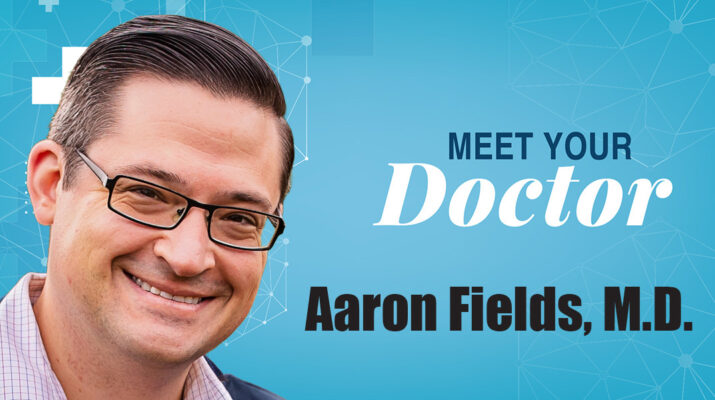
Nocturnist in charge of night shifts at Thompson Health’s emergency department has received one of the hospital’s highest awards. He discusses his work and why the lesson he learned from his childhood pediatrician has helped his career
By Chris Motola
 Q: What is the night shift like in an emergency department compared to the during the day?
A: It’d be a little tough for me to give a really clear answer because it’s been like eight years since I consistently worked day shifts. [At night] the things we’re able to do are a little bit more limited. There is not as much support staff around.
Q: What type of patients do you usually see?
A: There are a couple flavors of what’s coming in overnight as opposed to during the day. There is the truly emergent. They’re showing up because something happened suddenly and it couldn’t wait until morning. Then there are the people who have had this gradually worsening problem, but they’re also trying to juggle kids and a job and the only time they had available to take care of themselves was overnight.
Q: So, when you say you have fewer resources to deal with, is that primarily fewer staff working?
A: Yeah, so, we go down on staff both for physicians and nursing as well as a lot of the ancillary stuff. So, during the daytime, we have a lot more consultant services available where they’ll actually come down and see patients in person. We rarely if ever actually see our consultants come see people in person overnight, unless it’s something like truly emergent, like they need to go to the operating room within the next hour. Thankfully, because I’ve been here long enough, I’ve developed good enough relationships with my consultants that I think most of them trust me to give them reliable information and tell them if somebody is well enough to wait until morning or if they’re sick enough, to come in overnight.
Q: So how do you compensate? How do you spread yourself between the patients even?
A: It’s really variable. Like, a perfect example is last week; I had two shifts back-to-back. One was the slowest shift I’ve had in several years, probably since COVID-19. I had five patients in a 10-hour shift. And then the next night was one of the busiest shifts I’ve had in this similar time period, around 20 patients in a 10-hour shift. So, it’s so unpredictable and variable how many people show up, but then not just how many, but how sick those people are, how involved their workups are. And it’s not always the sickest people that take the most time and take the most work. In some ways, the truly really sick are the most straightforward and simple from an emergency department standpoint, because a critical resuscitation is fairly algorithmic. It doesn’t take as much creative thinking, so to speak.
Q: Despite the challenges of being a nocturnist, you’ve had a pretty good patient satisfaction level — you were recently recognized by Thompson Health with its Shining Star Award. So, you must be doing something right here.
A: I think it’s due to a lesson I learned from my childhood pediatrician before I went to college. She wasn’t pompous. She didn’t engage in a conversation with you from the perspective of “I am a doctor, I know more than you.” It really was like a conversation of one human being to another. And I’d like to think I have done a good job at kind of focusing my bedside manner on that sort of friendly, colloquial, non-paternalistic position. And I try to be really bluntly honest with patients when it’s appropriate, too. But then I also relate stuff back to my own health experiences. You know my favorite is when there is a lot of misinformation going back and forth about something like chronic Lyme. Is it a real thing? Is it not a real thing? And that’s one that I have an interesting vantage point on because of one of my close friends growing up. I think a little bit differently than some of my colleagues because, from what I understand, there is no defined evidence that chronic Lyme is real. But people are telling you they’re experiencing something and what they’re experiencing is real, whether it’s truly from the Lyme or not.
Q: It’s similar to long COVID in that way?
A: Exactly. And there are a lot of people who have had symptoms that they’re calling long COVID. So, we wonder is it an autoimmune process being triggered by other viral infections? And the more we look into it, the more we’re finding those things to have validity to it. And just because we don’t know or understand how something works, doesn’t mean it’s not happening. And I think there is a lot of smoke being blown up people’s asses collectively by doctors. We want to give an answer. People are so uncomfortable saying, “I don’t know.”
Q: Do patients actually respond pretty well to uncertainty?
A: We can’t always say you’re going to be OK. But we can tell them all of these tests are all reassuring. Your vital signs are reassuring. It doesn’t seem like this is something acutely life threatening. If it changes, come back. That’s what we’re here for. I don’t get a ton of complaints and that’s usually how I approach it when I don’t have an answer. And I think people dislike it more when you [aren’t truthful to] them and when you try to wedge their symptoms into some diagnosis that doesn’t quite fit. They can go Google things. They’ll look up the thing you are telling them they have.
Q: There is a lot that’s been said about the health and metabolic effects of working nights in any profession, but as a doctor, you’re probably especially aware of them. How do you deal with those?
A: So, before I made the decision to pull the trigger and go fully onto the night shift, I did a ton of research. I hemmed and hawed for a long time about whether to accept as somebody who has a very strong family history of Alzheimer’s, which is not a good predisposing factor to then go and work night shift because shift work and sleep disruption is one of the biggest risk factors for developing dementia and Alzheimer’s. There is a fantastic book called “Making Night Shift Work: A Practical Guide for the Night Worker” by Steve Frei I draw from as well as a Facebook group I’m in that discusses ways to minimize the impact. One of the things that the book recommended was, if you are able to group your shifts together so that when you are flipping your circadian rhythm, you can do it with less disruption. I decided early on that I would never use prescription sleep aids, because especially for people who have any family history or risk factors for dementia, medicines like Ambien and the rest of the Z drugs, those all drastically increase your risk for dementia long-term. My wife and my children have now started calling what I do “double sleep,” where I have a normal night’s sleep. I get up relatively early with my kids and then after they’re off to school, I go back to sleep and then I sleep as much as I can during that day. It’s usually six to eight hours, and then I get up and can start my nights. Sometimes, I wake up earlier in the afternoon because my brain has decided it’s had enough sleep and that’s fine.
Lifelines
Name: Aaron Fields, M.D.
Position: Nocturnist at FF Thompson Hospital
Hometown: Gaithersburg, Maryland
Education: Georgetown University
Affiliations: URMC Thompson Health
Organizations: American College of Emergency Physicians, American Board of Preventative Medicine; American Society of Addiction Medicine
Family: Wife (a pediatrician), three daughters
Hobbies: Home improvement, reading