
By Jennifer Faringer
 With challenging and uncertain times comes the inevitability of encountering stressful situations.
It is these very encounters that serve to strengthen one’s ability to cope and respond in ways that improve health and wellness which can be a benefit to both your personal and professional life.
We are all hardwired with the ability to respond to stress, however we always have a choice as to how we choose to respond to a stressful situation.
Some operate in a state of distress and avoidance, perhaps unaware that they are choosing to cope in ways that result in diminished health. Poor coping options could include the misuse of alcohol or other drugs, problem gambling, or other unhealthy behaviors. Others purposefully make a choice to meet stress head on. Stress then becomes a challenge and is seen from this perspective as a potential opportunity for growth.
We can use the analogy of the thermostat where we create a set point providing a level of comfort, whether heating or cooling our physical spaces. The same applies to our internal set points and the baseline from which we operate and respond to situations throughout the day. If our internal set point is one of distress and unease, we tend to respond from that point of view, returning to that distressed set point following the stressful encounter. The same holds true if our internal set point operates from the perspective of challenge, growth, and opportunity when we not only respond differently, we are also more apt to return to a healthier more productive set point.
Recognizing our baseline or set point is an opportunity to raise our set point and increase the likelihood of responding to daily challenges in ways that improve our health and increase our sense of wellbeing. With awareness and practice, we can learn to respond with resilience, and we can even begin to thrive where we experience a sense of well-being that’s even stronger than before experiencing a stressful situation. Resilience does not occur without first experiencing stress.
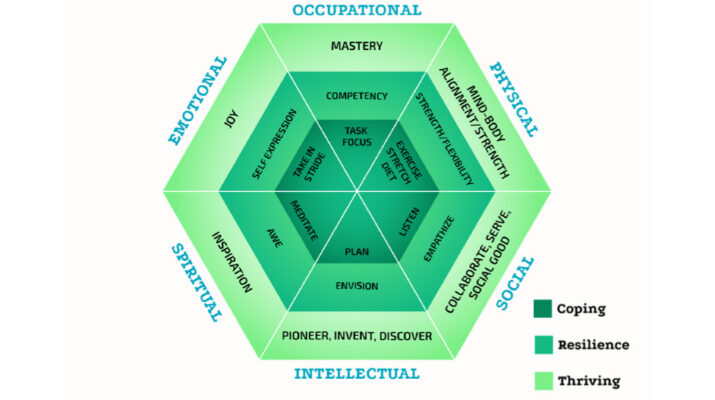
To further support these concepts, the National Wellness Institute (part of the Wellness Alliance) developed the Six Dimensions of Wellness which include emotional, physical, occupational, social, intellectual, and spiritual health. The model above illustrates levels of response within each dimension.
The dimension of emotional health shows that we can cope by taking it all in stride, we can build increased resilience by responding through self-expression, or we can demonstrate emotional thriving by responding from a place of joy. In looking at the occupational dimension (the workplace), we can stay very task-focused, we can become more competent where tasks become second nature, or we can thrive reaching a sense of mastery
To improve overall wellbeing in both personal life and the workplace, set realistic goals, request access to resources and tools and seek training on team building, managing stress, tasks, and workload. Work toward understanding and raising your set point, exploring ways to create opportunities for growth that enhance health and well-being.
Workplaces and businesses can request Team Awareness Workplace Wellness (TAWW) workshops provided by the National Council on Alcoholism and Drug Dependence-Rochester Area (NCADD-RA). These interactive workshops are available virtually or in person upon request and are offered at no cost complete with workbooks, activities and community referral resources for attending participants.
Available workshops include:
• The Ripple Effect of Wellbeing is a foundational workshop that explores the power of positive stress, the costs and benefits of health decisions, the strengths and resiliency of the team, and connectivity.
• Resilience and Thriving explores the effects of stress, healthy coping skills, and developing priorities for and a plan to improve health and wellness.
• Empowered Health Consciousness explores how to embrace a wellness-focused lifestyle, reduce substance misuse, and increase overall mental wellbeing.
For more information, contact:
 Jennifer Faringer at jfaringer@depaul.org, Team Awareness Workplace Wellness Coordinator Kara Cloud at kcloud@depaul.org or visit the NCADD-RA’s Team Awareness Workplace Wellness website page at https://ncadd-ra.org/services/team-awareness-workplace-wellness/.